Pin the Tail

I’ll tell you right up front, this particular blog post is going to cheat you a bit on your viewing pleasure.  Normally I try my best to give a healthy dose of pictures with each of my offerings.  When it comes to birds the goal is to give you a variety of poses or angles that help provide a good perspective of the featured species just in case you happen to live in one of those obnoxiously big cities and think birds just get in the view of the pretty skyscrapers.  Today.. not so much.  To be honest, I cannot recall what the issue was, but there was really only two picture taken of this bird – surprising since this was another NEW bird to check off the list.

The only hope is there are more shots of the Northern Pintail from the second day of shooting – which hasn’t been processed yet.  If I find more while in the digital darkroom for the those I’ll be sure and post them to make up for the sparsity here.  There is a correction for the long term readers of this blog.  Back on June 5th 2010 I suggested one of the bird shots on that post was a Pintail (although skeptical even then – link here).  Clearly it didn’t possess the twin tails of real Pintails as clearly seen in these shots.

This day began in one of those “Small World” experiences.  It was a little cool that day so I was sporting my Illini pullover.  While walking up to the entrance of the Preserve, a man came out and noticed the coat and asked me if I had gone to Illinois.  Always seems surreal to head out thousands of miles from home and then come across someone that lives a few hundred miles from your hometown.  He actually was the individual who alerted us to the presence of the Pintail.  Based on his excitement at the time it appears that was not a common sighting on the ponds.  A quick look at the regions indicates they do Winter there in that region, but since this was August that does seem pretty early.  From an artistic perspective, I find the color palette on these ducks to be gorgeous which is only enhanced by the sleek profile.  In case you are wondering, these two are both males.

How about some interesting facts to complete the post.  First off they are very abundant and therefore have a conservation status of Least Concern – follow up research indicates they are in a large decline so this may actually change in the future (sad).  They also happen to be a very popular game duck due to (and I quote Wikipedia) “speed, agility, and excellent eating qualities”.  Hey, look ad that purdy eyegil burrd leck’s put led in itz ass.  They are classed as dabbling ducks or simply those ducks that feed off the water’s surface instead of diving.  They are primarily plant eating animals with the exception of when the female is nesting.  During that time,  it changes to invertebrates likes insects – wonder if that is similar to us humans which tend to switch to ice cream and pickle juice during our “nesting” period.  Interesting.. another site indicates they are the first ducks to begin their Winter migration.  I think we can personally confirm that now!  And lastly, the ducks organization website indicates that Northern Pintails have a circumpolar breeding pattern.  Know what that means?  … ‘cuz I have no clue hehehe.  Current guess is they only have sex when circling a polar bear.  Trust me, I’m an Eggspert on dem der wingy things.

That’s all folks – my apologies again for the lack of pictures – good news is you could read the whole post without a jump.

Hefner Would Be Proud

Admittedly, when things get tight I go to my ace in the hole.  Lucky for me, I was able to finish processing all the shots from our first day at the Henderson Bird Viewing Preserve.  If you recall, on our trip to Nevada last year we stopped in to that gem of a preserve.  Per previous posts, this area already provided two blog posts for brand new birds to my collection – specifically, the Green-Winged Teal (link here) and the Greater Roadrunner (link here).   Here’s a little secret.  Those were not the only two new birds this shoot produced!  I was able to add another new check in the bird list with today’s blog entry.

Anyone want to take a guess on what this might be?  Really take a guess – a little validation would help me at this point.  This little bird took me some extra time to eventually come to a consensus on what it was… or actually what I think it is.  To accomplish this I employed my brand new bird reference guide I picked up while out in Yellowstone.  While perusing the various gift shops in the park, The Stokes Field Guide To The Birds of North America caught my eye.  It isn’t often a book on birds shows up I do not already have, much less ever seen.  The key aspect of this particular reference was the ABUNDANCE of pictures.  None of the books on my shelves come close to  having the quantity of actual photographs contained in this book – in particular the fact it has shots of the female, the male, the juvenile and even seasonal and regional differences.  Truly awesome and it was instantly “mine” – didn’t hurt we got a discount being Yellowstone Association members but truth be told I would have gladly paid full price (shhhh don’t tell anyone).  After about 40 minutes of thumbing through the book I decided to go with … drum roll .. a Verdin.  The only concern was the region but a closer look (need a brush up on my state shapes) shows that it does venture into Southern Nevada.  A friend at work (thanks John!) helped me verify the region today so thinking that concern is past me.  As with any bird post at Lifeintrigued – you are more than welcome to debate any identification.  So for now were going with a Verdin.  This bird is especially cool since it doesn’t come anywhere near where I live making the trip that much more fruitful.

According to Stokes, this bird prefers desert scrub along washes and streams.  The desert part was dead on and it was alongside one of their ponds which kinda fits the water reference.  That is about the sum total of info I got out of the book.  Again, that was purchased to help identify the bird, I have our friends over at Wikipedia and an abundance of info on the web to fill the data gap – finding out what the hell it is the real battle.  Another site did mention they like thorny scrub – based on the shot above and the one below, this one was right at home.

Hit the jump to read more about this cool looking bird.

Continue reading Hefner Would Be Proud

Being Bryson

It’s a pictureriffic post today!  Well, definitely in the sense of quantity, but in truth it is a rather hodgepodge collection if I do say so myself.  The topic today happens to be something that I have in common with Bill Bryson – we both like a good Walk in the Woods (link here).  One glaring difference is he had the opportunity to do his walking on the Appalachian Trail were I tend to stay a little closer to home.  Some day I’d like to actually do that legendary trail but there are a number of items ahead of it on the Life List as of now.  Just a quick note on Bill Bryson – he is one of my favorite writers up there with AJ Jacobs.  Something about his dry wit that makes me crack up every time I read or listen to one of his offerings.  He has a very British feel from spending a significant amount of time in that region, but his perspectives of a Midwestern life are dead on.  I recommend starting out with “A Short History of Nearly Everything” (link here) to get a feel for his style and maybe even learn a thing a two along the way.

Back on topic, one of my favorite past times is hiking waterways.  Hiking is a great way to get out and experience the best the outdoors has to offer.  No cars to stress over, forces you to unplug from the electronic media push industry and helps you forget that this administration has (as we’ve come to expect) abused the Patriot Act.  Just you, a good pair of boots, a pair of leather gloves, protective eye wear, a hat, a camera and depending on the time of year maybe some bug repellent.  Now there is one other convenience I do recommend for two reasons – a smart phone.  Obviously, the ability to call in help in an emergency is the major benefit, but the GPS capability is pretty cool for tracking your route and distance.  Case in point, here is the results of my hike back in April.

It is difficult to tell at that zoom level, but that trail directly follows a stream which is a feeder for the Kickapoo Creek.  This is the same stream that runs through my property which I had already mapped on a previous outing.  On this particular hike I wanted to continue it through Jubilee Park.  So, why the fascination with streams and rivers?  It’s quite simple really – first, it is virtually impossible to get lost and secondly, that is where the wildlife hangs out.  My rule is to choose a side of the stream and walk along that side as close as possible to the bank following every switchback and fork that keeps you on the same side of the water.  If you get lost.. simply retrace the stream and it will lead you back to the start as opposed to trying to navigate in open woods which can be a nightmare (trust me, been there).  It also makes it very easy for rescue teams to find your body should something go awry (don’t ever use this as the argument, your significant others tend to get a little nervous).  Now, this rule does need to be broken every once in awhile – such as when a fork eventually takes you way out of the way or when you get caught in between another merging stream.  That is what happened to me at mile 2 above.  Conforming to the rule, the hike took me back on a merging stream until eventually there was a horse crossing I used to get back on the right side of the main stream (if I would have stayed on it it would have taken me back out of the park).

Granted the hike will do your body good, but it’s the sights and sounds that give me the greatest enjoyment.  All the running allows me the freedom to trudge through the thickets, briars and weed for as long as I want allowing me to  explore wide sections of the woods at a time.  You never know what you will find on a given trek no matter how many times you’ve already covered that area in the past.  In a macabre sense you just never know what might have met their demise along the bank.

Truthfully, this is a pretty common scene on my walks.  For one thing it is apparent deer head to the water when something is wrong.  Not sure of the reason, but multiple hunters have informed me that deer they’ve shot tend to run directly toward water.  Most of the deer carcasses I encounter are not felled by human hands and appear to the handy work of coyotes or possibly simply old age.  Now for a little secret.  The spine of deer tend to solidify when they die.  Why mention this?  ummm it happens to play into a little quirk – I like to arrange the bones as a little surprise to fellow hikers.  Specifically, I either place the skulls in the “V”‘s of trees or better yet….

… stand them up along the banks.  This particular valley near the stream was FILLED with deer bones and a few full skeletons.  The full ones were positioned in various arrangements around the value like they’re still alive.  Wish I could videotape anyone who comes upon them hehehe.   Don’t worry, the rest of the shots are from the land of the living.  Hit the jump to check out all the birds found along the hike

Continue reading Being Bryson

One Fast Cuckoo

Another day, another post!  Guessing the doubters are starting to get a little concerned (hehehe).  I’m not out of the woods completely, but as each post rolls out through the publishing pipeline the stress ratchets down another notch.  The good news in all of this is I was able to get started on another vacation’s worth of shots from last year.  The great news is it looks like the topic hopper will be full for an extended period of time based on activities that has transpired as of late.  Of course, this does have the downside of erasing all the gains made on the already overflowing topic queue.  A very good problem to have when all your peeps have such high expectations.

Speaking of queues, next pop from the stack places us back in Henderson Nevada, home of the Henderson Bird Viewing Preserve discussed a couple of posts back (link here).  If you recall, that post introduced a new bird to the blog.  Let’s continue that streak with still another new species.

Most people will recognize this bird thanks to the numerous references over the years.  If you are struggling, imagine it as a highly clever bird painted in blue and yellow.  No help?  How about Beep Beep?  If that didn’t trigger the name, then clearly you did not watch enough cartoons as a kid.  Just in case the suspense is too high, this is a Greater Roadrunner.  That day in Henderson officially marked the first time I’ve ever seen a live one of these and to say I was elated is an understatement.  After shooting the Green-Winged Teal, a blur of brown and white caught my eye dashing across the shoreline of an adjacent pond.  Intrigued,  I immediately headed over there and tried to get a decent shot.  Let it be known that the amazing speed of these birds is confirmed.  It could flat out move making focus tracking nearly impossible.  Left, right, under brush, out of brush, to the water, back to the shore – it never seemed to stop.  To get the shots here required some high shutter speeds combined with just a smidgen of luck.  Tracking brown colored birds against a brown backdrop makes for interesting times with the Beast, but when you get it… you generally get it.

Hit the jump to read more about this runner’s friend

Continue reading One Fast Cuckoo

Hitting Jackpot in Henderson

Having finally made my way through the Indy Zoo photo shoot, I can finally switch my attention to another photo trip that has been lingering out there way too long. Last November Linda and I headed out to our home away from home in the plains of Nevada. As in the previous time we hauled out our camera equipment with the primary intent of heading out into Red Rock. Turns out one of employees that works for Linda had lived out there. When she heard I was into bird photography she highly recommended we popped over to Henderson and make a visit to their Bird Viewing Preserve. Without hesitation this spot was added to the agenda figuring we could drop by on a late morning before packing up and moving out to the Red Rock staging area (translated.. one of our casino “finds” from a previous trip). The day we went was somewhat of an emotional roller coaster. There was high anticipation on the ride out, but as we neared the location (per the GPS) that started to taper quickly. Spoiled from the preserves around us in Illinois, I expected a mini forest – on hind sight there was no basis for that assumption seeing as how we were in a … DESERT. The GPS kept telling us we were headed in the right direction, but all that really stood out was industrial type buildings and a water treatment plant. You would think there would be a large lake or something if they had any hopes of pulling in waterfowl. Linda eventually found a small sign pointing to a road that wrapped back behind the industrial complexes. This brought us to a small building with exactly one other car in the parking lot. The coaster had just bottomed out.

With subdued enthusiasm we got all the gear ready and headed into the building where we were greeted by a gentleman who instructed us to sign in. Additionally we were required to sign a special form indicating we understood the rules and wouldn’t harm anything. Hmmmm – that at seemed a little odd. That form was basically good for one year before you had to fill it out again. This slight annoyance was forgotten soon enough when we discovered that the Preserve was FREE. In this day and age that is becoming rare. With the paperwork out of the way, we headed out back to see what this was all about. Remember that coaster comment? well it took a massive ride up a few minutes later. There were approximately 140 acres (according to their website) dedicated to the facility with a series of ponds carved around a nice walking path. Oh, and they did have some trees. I was floored, not sure my shutter finger ever left the camera for more than 10 minutes as we moved from pond to pond. That place was packed with birds I’ve never seen before and according to someone we met there, a current stopping point for some rare migrating birds. A personal jackpot in the land of excess. As with the Indy posts, these will take some time to get through, but as before I’ll sprinkle in some other topics to keep the non-bird enthusiasts entertained.

Starting out this series is another new entry to the Blog:

That would be the Geen-Winged Teal. From the maps I have (Audubon) it looks like their permanent residence extends down into Nevada, however, preferring the Canada regions during the summer breeding and the bottom half of the states during the Winter months. It does show that it migrates through Illinois but do not think I’ve encountered one to date.

Hit the jump to read more about this sharply colored bird

Continue reading Hitting Jackpot in Henderson

Goslings Lounging

Looks like our wonderful 67 degree weather day is going to transition to rain pretty soon.  Good thing I got my run in earlier.  if you recall, I’m in the midst of a Project Austin and today marked the first time on the road since three visits to Accelerated Performance.  Today was all about working on the list of things I need to change in my running form (and that list is long).  The good news is the tweaks resulted in very little pain in the hamstring – definitely a plus since that area usually flairs up during every run.  Maybe those torture deep tissue messages are going to pay off or it is simply terrified that if it makes its presence known it will get the hell gouged out of it again.  With the good news is a little bit of bad news.  Apparently these changes are engaging a different set of muscles that have been neglected due to the injury compensating.  At about mile 4 started feeling the effects and ended up backing down to only 5.5 miles today.  This wasn’t meant to be a quick journey so not concerned yet – real test will be next week to see how quick those neglected muscles are going to take before they kick in.  For now it’s just all about the rest.

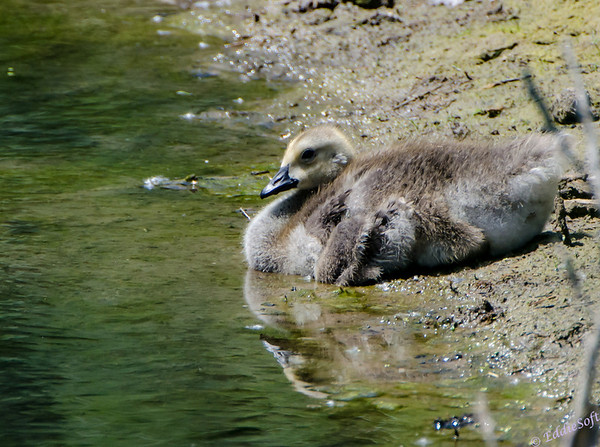
Speaking of resting, that is the theme of today’s post.  Apparently my last post scared some of our readers (okay, some being ONE but she has some power over me).  Who wouldn’t want to curl up next to a badger? all fluffy for comfort and you know, NO ONE will mess with you if you are sleeping next to a BADGER (especially a Honey Badger because those are just bad-ass).  Instead I get a plea for a more pleasant looking animals.  Sigh, figured I get kudos for bringing something new and intriguing but instead I get a fear response – not unlike when your lovely wife finds a mouse in the car.  Fortunately, the badger wasn’t the only wildlife we captured that day.  Rifling through the shoot I decided on something more cute and plushy but added some contrast to it by taking it in an icky setting.

This isn’t the first time we’ve featured Canada Goose goslings here at LifeIntrigued (link here) but this is probably the nastiest setting I’ve bothered taking them in.  We had just arrived at the park and was caught off guard by the crowd of visitors.  Generally there is not problem parking in the close lots, but that day we were parked way out on a back road.  On our trek to the entrance these goslings caught my eye – yes, I did say goslingS!

Hit the jump to read more about these cuties

Continue reading Goslings Lounging

A Moving Icon

For the obvious reason, February is the bane of all bloggers with a quota. Rather than take the extra time for the prep on some projects I’ve been working on, figured we’d just close out this short month with the last set of Indianapolis Zoo birds. Don’t think you are out of the woods (err the zoo) yet. There’s one post left based on some elemental mammal experimentation, but for now… let’s go with the pinks.

There is no mistaking these birds and I’m pretty sure they are universally known. They can be seen at a majority of zoos, wildlife sanctuaries and even Vegas if you look hard enough.  They have even been known to show up in the yards of unsuspecting new homeowners. In case you have your head in the sand, we’re talking about the Flamingo.  These aren’t just your everyday Flamingos either.  No sir, these are Flamingos that have been shot in harsh light.  That would be a clever way of stating these shots are not going to be making it into competition anytime soon.  I threw all the recovery I could at it, but the conditions were just not the greatest when we made our way to their little pond.  The thing about shooting Flamingos is they are relatively skinny and can be very long.  Good characteristics for a model, but this forces some creative composition decision.  You can choose to go close and draw out detail in the head by cropping down as in the image above.  Rather than just throw a decapitated head out there I kept some of the body to provide a foundation for the shot – see, I’m learning from all those composition questions I keep asking you about.  I actually like how that shot turned out – yeah, I followed the rules of thirds which is pretty common for me.  In truth it is more about giving the subject room to breath in the frame – tight crops put a virtual cage around animals which tends to grate on us wildlife photographers.

If you are feeling a little cruel, you can relax your composition a bit to provide a sense of height.  Pulling back a bit you can incorporate some of the leg structure into the shot.  Now you have more of a visualization on the tall stature of the bird, but at a cost.  You lose some detail in the face and it starts to get lost in the vastness of the surroundings.  The other downside… is it essentially whacks off the rest of the bird’s legs.  The unwritten rule is you never crop a person’s legs above the knee – trust me, it just looks wrong. Although this is not as severe, it still bothers me a bit.  I will say, having a small part of the knee helps some.

Hit the jump to read more about this pink birds … and you get a BONUS!

Continue reading A Moving Icon

Birds of the Desert Biome

As promised previously, it is time to start rolling out the birds from the Indianapolis Zoo trip back in 2011.  Now that most of the mammals and the lizards have been sufficiently covered, it is time to feature our feathered friends.  The downside of this is once again I’ve become extremely frustrated with the resources available for bird identification.  It is becoming almost comical how little information I am able to obtain from the web for what seems like the simplest tasks.  For example, there are aviary identification sites out there that allow you to do identification based on attributes.  It will seem promising at first since it lets you pick some easy body geometry but then you become less than enthused when the all knowing database comes back and says it could be … and then shows at best one or two options.  Does it have long longs?  well then you have a Heron.. what about Stilts.. no, you have a Heron.  Does it sit parallel to the tree? then it is a Woodpecker…. what about Flickers … I said it’s a Woodpecker now leave me alone.  This even holds for what appears to be easily identifiable birds which I’ll get to in a bit.  Now, there is blame to go around here.  Clearly this would have been an easier task had I found a resource at the zoo to ask or found a placard on the habitat that gave the name of the contents.  Lesson learned for future zoo trips that might have a collection of birds more rare to the continental Americas.  The counter to that argument, it doesn’t seem like a stretch to ask the Zoo to list the names of their animals on their web page – Indy has a few listed, but again, one of them has gone unidentified.  Sorry for the continual gripe about identification, but it is frustrating to page through thousands of pages or image query results and come up empty on a bird I’ve captured. (feel like my brother and his frustration with Costco!)

The good news is only one of this set is nameless.  One that was identified is the Gambel’s Quail.  Or, as the Indy Zoo website calls it – Gamble’s Quail (link here) – pretty bad when you can’t rely on the zoo to get the names right.  These birds are actually pretty odd looking with their head protruding plumage.  This bird, along with all of them actually, came from the Desert Biome exhibit.  This is the same location all the lizard shots came from in the previous posts.  Apparently birds and lizards tolerate each other pretty well.  There were a few other shots taken of this bird, but it was spending much of its time hanging out in the back-lit windows – not a good setting for getting real detail in a bird.  Eventually I worked myself around to get a decent headshot.

A very distinctly featured bird don’t you think?  This is a male specimen easily identifiable by its blacker beak and eye coloring.  They are a sport bird but Wikipedia does list them as Least Concern on their conservation status.  This may be due to the fact they lay a lot of eggs at once – 10 to 15 eggs at a time giving them a higher survival rate.  Common to the Quail family, the Gambel’s prefer the ground over flight but they can utilize those wings if they choose – short distances.  They do indeed prefer the desert even though that surprised me when I saw this in the biome exhibit.  In case you are curious, they are named after naturalist William Gambel (my apologies for the zoo in screwing up your name).  He died of typhoid back in 1849, but not before discovering this bird, the Mountain Chickadee and the Nuttall’s Woodpecker.

The next bird was also easily identified.  The zoo site referenced them by their third name – the Owl Finch, but they are also referred to as the Double-Barred Finch and the Bicheno’s Finch. So loved they gave it three names.  Guessing they have the Owl name thanks to the coloring around their eye mimicking their larger brothers.  It is almost as if an artist took a standard finch and decided to dress it up a bit – kind of like what they do with those cow and pig statues you see littered about larger cities.

That shot gives a really good perspective of the Beast’s depth of field.  The finch (a small bird) is perfectly centered in the band of focus – as any bird photographer will agree, the focus  target is always the eyes so compositions like these tend to extend the focus past the bird.  I had to laugh at the next shot – clearly a day of shooting the mammals had influenced my composition choices on the birds.  Always the sucker for head across the body shots.

You are probably wanting a shot from the front to see what this bird looks like.  That is an easy request because there were a few of these birds in the exhibit.  The one below was a little more active than the one simply hanging out in the rocks.

Hit the jump to read more about the Owl Finch and two more of its colorful brothers.

Continue reading Birds of the Desert Biome

The Brent Chapman of the Birding World

Merry Christmas everyone!  I was sitting around on Christmas Eve and wondering what a fitting topic would be for this festive day.  I decided I’d hold off a little more before I go off on the latest gun restriction talks and it didn’t seem right to post a recent experience with a deer (it is pretty gruesome and didn’t want Santa to get offended).  There’s the Hank Williams Jr. recollection (NOT) and I am not ready yet for either the Wisconsin trip post from earlier in the year and much to soon to go with the recent Vegas birding shots.  What to do, what to do.  Hey, nothing says Christmas like a super fisher!  Okay, it is really a gift to me to help pad some year end stats but it actually has a tie in to the last post on Allerton.

While processing the statue shots from the Allerton Park shoot (link here), a pleasant surprise caught my eye.  In the middle of shooting the Loch Ness shots a familiar sound emanating out from the nearby woods.  A sound that caught my attention having heard it for the first time a few weeks prior to making the trip up to Monticello.  Imagine, if you will, a long rattle – somewhat like a cricket on steroids.  Immediately the Beast was reoriented to the location of the sound in hopes the source would show itself.  A few minutes later a now “familiar” crested blue bird flew out of the woods and took a position in the trees along the bank of the pond.    “Familiar” may be  a strong word since it was still pretty new to me, but to my credit I had taken over 200 pictures at the first encounter.  You kind of get to know a bird after staring at it for that many shots.  The original shoot was at Jubilee Park and those shots tended to come out nicer so let’s lead with those.

And here it is:

If this is new to you, you might assume a common Blue Jay from the similar coloring.  However, the beak may be throwing you off… and if not, it should be.  That beak is HUGE!.  Add to that the overall large relationship of the head to the rest of the body pretty much eliminates the Jay.  This is actually a Belted Kingfisher and a brand new bird to the Blog.  This is one of those birds that is supposed to be common to our surroundings, but was never in the right spot at the right time.  That is until Linda and I took a quick run over to Jubilee Park to see what was hanging out around the pond. This is becoming a hot spot for new birds for us.  If you recall, this is where we shot the Green Heron (link here).  Not only were we at the right spot.. we had the Beast.

Without the Beast this would have probably been a missed opportunity.  Our subject (a male) was keeping its distance and really didn’t appreciate me being in his hunting area.  He would give me about 4 shots before fluttering off to some other branch.  Even with the large glass the bird was buried in tree branches for most of the time throwing the auto-focus all over the place.  The entire time I was shooting it, my assumption is it had a white eye and the light was working in my favor giving a nice glint.  During post processing, it became apparent that this was wrong.  The Kingfisher actually has a black eye – the white is just part of the base of the beak coloring.  This is why you never trust the LCD screen on the back.  Although it could not be seen while looking through the glass, the culprit for the focus walking was the twig positioned right in front of the bird – again, too small to see in the eyepiece or the LCD screen.  The shot below gives a good view of the eye in relationship to the white spot.

Some interesting facts.  The female Kingfisher actually has a burnt orange band on the belly – odd since the male is usually the more colorful of the sexes.  They are very common in North America (could have fooled me). They are year round in our neck of the woods (Illinois).  According to our friends over at Wikipedia, they actually nest in the banks of streams/ponds making an upward slanting tunnel to help guard against flooding.  As you would expect they carry a Least Concerned conservation status – again, hard to believe this was the first time I’ve really come in contact with one.

Hit the jump to see more shots of the Belted Kingfisher

Continue reading The Brent Chapman of the Birding World

Birds of the Concrete Jungle

Yikes, I’m once again cutting it close … verry verry close this month.  After this post I’ll still have another to go and right now not sure what that is going to be.  But that is in the future and I’m living in the now.  Recently we had the opportunity to visit Sin City, our home away from home.  We have been using Las Vegas as a launch pad for photography shoots.  If you recall a few years back we hit Zion (link here) while we were out there and this year we had similar plans to hit some scenic sights with a little less driving.  Turns out I was able to do some bird watching while hanging out on the strip!

First on the list is the very entertaining Barmingo.  This particular bird is rarely seen in the daylight preferring instead to spend its time at local happy hours and whatever hot new club is all the rage.

Basically being inebriated for a most of it’s adulthood, this particular bird has evolved into a clever self-preservation posture.  Thanks to the lack of control of it’s legs, it spent the early years stumbling on every curb and uneven tile in the city.  This proved a painful burden on the body which developed a permanent pink hue from all the bruising.  Unfortunately, due to not having an means to stop itself, the beak took blast after blast from the ground resulting in the bulbous appendage we see today.  Somewhere along the line it figured out it could prevent a lot of serious injury by adopting a different posture – one that allowed it to maintain better balance by placing the weight of the head over center mass and giving a much cushier landing should it stumble off the bar stool.  There is still one feature that has not changed

They can’t hold their liquor.  Quite sad really – they could have been so much more…  As a word of caution you might want to reconsider playing in any local Vegas fountains – they tend to be covered in Barmingo vomit.

Hit the jump to see the rest of the birds we found hanging out in the Concrete Jungle we call Vegas

Continue reading Birds of the Concrete Jungle